corporate@paleontraining.com WhatsApp +44 7508 823495 Mon–Fri, 10am–7pm WAT For Graduates →

Corporate training in Nigeria Cybersecurity awareness training in Nigeria

Corporate cybersecurity training for Nigerian organisations

CyberSecure Workforce: Cybersecurity Awareness Training for Businesses in Nigeria

Your people can be your strongest defence. Train them to spot it, stop it and report it.

Many cyber attacks on businesses start with a person, not a system: a fake supplier invoice, an "urgent" message from the MD, a login page that looks real. Paleon Training gives your employees practical cybersecurity skills they use every day. The programme is for banks, fintechs, oil & gas and energy companies, telecoms operators and growing businesses across Nigeria.

Company onboarding: 10 slots left for December 2026 start. Each slot covers portal setup, your staff sign-up link and a manager login for one organisation. Individual places bought online start today.

  • Self-paced online, in your own private company portal
  • Built for non-technical staff
  • Covers AI-related risks
  • Supports ITF reimbursement claims
Nigerian finance team checking a suspicious payment request on a laptop in a Lagos office.

CyberSecure Workforce is a corporate cybersecurity awareness programme from Paleon Training. It helps employees in Nigerian organisations recognise common cyber threats such as phishing and payment fraud, protect business information and report suspicious activity quickly.

Business outcomes

Fewer incidents that start with a person

Fewer phishing and payment-fraud losses

Staff learn to stop and check fake invoices, urgent payment requests, changed bank details and look-alike login pages before money or data leaves the business.

Faster reporting of incidents

Every employee knows what to report, how and to whom, so suspicious activity reaches your IT team in minutes, not days.

Audit and data-protection readiness

Completion records and assessment results give you evidence of staff training for audits, the board and your obligations under the Nigeria Data Protection Act 2023 (NDPA).

We agree how to measure these with you at the start, for example phishing-report rates, time saved on named tasks or policy sign-off, and review them with you at the end.

The challenge

Your employees are part of your cybersecurity defence

Good technology matters, but it cannot do the whole job. Attackers often go around the firewall by persuading a person to help them. Risks grow when staff:

  • click a link in an email that looks like it came from the bank, a regulator or a supplier
  • approve a payment after a convincing request "from the MD" by email or WhatsApp
  • pay a fake invoice after a supplier's bank details "change"
  • reuse the same password for work and personal accounts
  • share customer or staff information with the wrong person
  • use unsecured phones, laptops or public Wi-Fi for work
  • paste confidential information into public AI tools
  • ignore warnings, or do not report something odd because they are unsure

None of this needs bad intent. It needs people who know what to look for and what to do next.

Nigerian colleagues discussing a suspicious WhatsApp message in an Abuja office.
The solution

Turn your employees into a stronger line of defence

CyberSecure Workforce builds six habits:

  • Recognise. Spot phishing, impersonation and fraud attempts.
  • Think. Pause and check any request involving money, passwords or data.
  • Protect. Use strong passwords, multi-factor authentication and safe devices.
  • Report. Tell the right person quickly, without fear of blame.
  • Respond. Follow the organisation's incident steps.
  • Improve. Make safe behaviour part of everyday work.
Business benefits

What your organisation gains

Reduce human-related risk

Employees recognise common threats before they cause harm.

Improve security awareness

Stronger day-to-day habits across every department.

Protect company information

Staff handle customer, staff and financial data responsibly.

Strengthen phishing awareness

Fewer clicks on suspicious links and attachments.

Improve incident reporting

People know when and how to report, so issues surface sooner.

Support remote working

Safer habits for staff working from home, sites and while travelling.

Improve AI security awareness

Staff use AI tools without exposing confidential information.

Build a cybersecurity culture

Security becomes part of normal work, not an IT-only topic.

No training can stop every attack. CyberSecure Workforce reduces the risks that come from people, alongside your technical controls.

Course structure

12 practical modules in 4 stages

Stage 1 Understand

  1. 1
    Cybersecurity Made Simple. What cybersecurity is, why businesses are targeted, and why every employee has a role.
  2. 2
    Phishing & Social Engineering. Fake emails, texts, calls and messages; business email compromise; fake invoices and payment requests. The habit: STOP → CHECK → REPORT.
  3. 3
    Passwords & Account Security. Passphrases, password managers, multi-factor authentication and account takeover.

Stage 2 Protect

  1. 4
    Email & Communication Security. Email, Teams, Slack, WhatsApp, video calls and file sharing: right recipient, safe links, no oversharing.
  2. 5
    Device & Endpoint Security. Laptops, phones, USB drives, updates, screen locking and lost devices.
  3. 6
    Data Protection & Confidentiality. Recognising sensitive information, secure sharing, access and accidental disclosure.

Stage 3 Work safely

  1. 7
    Remote & Hybrid Working. Home working, public Wi-Fi, VPNs, shared computers and working while travelling.
  2. 8
    Social Media & Online Safety. Oversharing, fake profiles and what attackers learn from public posts.
  3. 9
    AI & Cybersecurity. AI-written phishing, voice and video deepfakes, and what never goes into an AI tool.

Stage 4 Respond

  1. 10
    Malware & Ransomware. What they are, warning signs, and what to do if you suspect an infection.
  2. 11
    Insider Threats. Accidental, careless and deliberate insider risk, handled through awareness, not suspicion.
  3. 12
    Incident Reporting & Response. STOP → DISCONNECT → REPORT → DOCUMENT → COOPERATE. Early reporting can help reduce the impact of an incident.
Who it is for

Who should attend?

  • Senior leadership: CEOs, Managing Directors, Directors and Senior Managers.
  • HR and people teams: HR Directors, HR Managers and Learning & Development teams.
  • IT and digital teams: IT Managers, Digital Transformation and technology teams.
  • Operations: Operations Directors and Managers, and administration teams.
  • All employees: anyone who uses email, a phone or company systems.

Sectors we design for in Nigeria: banking and financial services, fintech, oil & gas and energy, telecommunications, healthcare, government, education, manufacturing, retail, logistics and professional services.

By department

How each team uses it

Finance

Spot fake invoices, changed bank details and "urgent" payment requests from executives.

HR

Protect staff records and recognise fake requests for payslips or personal data.

Sales

Protect customer data and the channels customers use to reach you.

Marketing

Secure social media and advertising accounts against takeover.

Operations

Spot security gaps in everyday processes, approvals and field work.

Management

Recognise executive impersonation and business email compromise.

IT

Reinforce staff awareness alongside technical controls.

Practical learning

Don't just learn cybersecurity. Practise it.

The programme changes behaviour through practice. Participants:

  • spot phishing in realistic emails, texts and WhatsApp messages
  • check suspicious links and attachments safely
  • recognise social-engineering tricks in short scenarios
  • find weak security habits in a sample workplace
  • decide what can and cannot go into an AI tool
  • respond to a simulated incident, step by step
  • write a personal cybersecurity checklist
  • agree security habits for their own department
Workplace scenarios

Cybersecurity training should reflect real work

Every module uses short scenarios. Participants decide what to do, then discuss why.

The urgent email: "the MD" asks for gift cards or a same-day transfer, and says not to tell anyone

What should the employee do?

The changed bank details: a regular supplier emails new account details just before a payment run

How do you confirm it is genuine?

The unexpected login prompt: a sign-in approval request arrives on your phone when you are not signing in

Routine, or someone with your password?

The confidential AI request: a colleague wants to paste a customer contract into a public AI chatbot

What should they consider first?

The lost laptop: a company laptop goes missing on a trip between Lagos and Abuja

What should happen in the first hour?

The suspicious attachment: an unexpected "invoice.zip" arrives from a known contact

Open it, or check first?

The programme ends with the CyberSecure Workforce Challenge. Participants work through a set of mixed scenarios, name the risk in each and explain the right response.

Handling information. Staff learn a simple four-level way to sort information: Public → Internal → Confidential → Highly sensitive. Each level comes with clear rules on where it can be stored and who it can be shared with.

A culture of reporting, not hiding. Reporting a mistake quickly is better than concealing it. The programme encourages clear reporting channels, management support and, where the organisation agrees, no-blame reporting.

AI + cybersecurity

AI is changing cybersecurity

Employees now need to understand both sides.

How attackers can use AI: more convincing phishing with fewer mistakes, cloned voices and fake videos of leaders, fake documents, and social engineering at scale.

How employees can use AI safely: keep confidential information out of public tools, check AI output before using it, follow the company AI policy, and verify any surprising request by another channel.

Want your teams to use AI productively as well as safely? See AI Workflow Productivity & Process Transformation.

For IT, risk and digital teams who need deeper skills, see the AI + Cybersecurity Professional Accelerator.

Nigerian accountant verifying a supplier's bank-detail change by phone.
Two ways to buy

Online: per learner, or in a private company portal

Option 1 · fixed price

Self-paced online

₦55,000 per learner

  • Each learner works through CyberSecure Workforce in the Paleon portal, at their own pace
  • 12 months’ access, quizzes, a final assessment and completion records
  • Volume discounts from 10 learners; buy online and start today

Worked example: 25 staff × ₦49,500 (10% volume discount) = ₦1,237,500, plus VAT where applicable.

Option 2 · by proposal

Private company portal (by proposal)

Your organisation gets its own private space in the Paleon portal. Staff join with one sign-up link, and your HR or L&D lead tracks progress from a manager login.

A private online space for your staff only

  • Your own company space in the Paleon portal, for staff anywhere in Nigeria; staff join with your company sign-up link
  • For whole departments or an organisation-wide rollout
  • Invoice available on every order. Pay online by card, bank transfer or USSD, or tick “Send us an invoice” and we’ll email one within one working day.
  • Managers see each learner’s progress; completion and attendance records for your files

Worked example: tell us your departments and headcount in a 20-minute call, and we reply with a proposal within one working day. All training is online and self-paced: there are no live or facilitator-led sessions.

ITF reimbursement. Nigerian employers that pay the ITF training levy can use our attendance records and programme documentation to support a reimbursement claim; eligibility and the amount are decided by the ITF.

Packages

Three ways to run the programme

CyberSecure Workforce self-paced places

Typical length: Own pace, 12 months' access

For: Teams of any size, starting today

Core training on phishing, passwords, data protection, remote working, AI security and incident reporting, with knowledge checks, a final assessment and certificates of completion

CyberSecure Workforce Transformation (private company portal)

Typical length: Own pace, customised

For: Organisations wanting a broader improvement programme

Assess → train → practise → measure → improve → report, all online: department modules, incident scenarios, and a summary report with an improvement plan

One product, online, per learner or in a private company portal. CyberSecure Workforce is the programme name everywhere. Every package is studied online, at each learner's own pace, in a private company space in the Paleon portal, with 12 months' access. There are no live, facilitator-led or hybrid sessions. Self-paced places have a fixed price per learner; private company portals and Transformation are priced by proposal.

Penetration testing, security engineering and infrastructure assessments are specialist services. They are not part of this programme and would be scoped separately.

Pricing

CyberSecure Workforce prices in Nigeria

₦55,000 per learner, online self-paced, 12 months’ access

Volume discounts for your organisation
LearnersDiscountPrice per learner
1–9 learners List price ₦55,000
10–49 learners 10% off ₦49,500
50–199 learners 20% off ₦44,000
200+ learners 30% off ₦38,500

All three programmes for the same person: 15% off, ₦361,250 per learner for CyberSecure Workforce, AI Workflow Productivity and the AI + Cybersecurity Professional Accelerator.

Outside Nigeria, South Africa, Kenya and Ghana? Pay in pounds: £45 per learner, with the same discounts.

Prices are per learner for the online self-paced programme in the Paleon portal, with 12 months’ access, plus VAT where applicable. Volume discounts apply to the number of learners on one programme. The all-three discount and volume discounts do not combine; you get whichever saves you more. Invoice available on every order. Pay online by card, bank transfer or USSD, or tick “Send us an invoice” and we’ll email one within one working day.

Buy learner places online

Pay securely on Flutterwave by card, bank transfer or USSD, or tick “Send us an invoice” and we’ll email one within one working day. Your staff sign-up link is emailed to you as soon as the payment is confirmed.

You will use this email to create your manager login. Each learner who signs up with your link uses one place. Prices exclude VAT where applicable.

Rolling out to the whole organisation? We set up a private company space for your staff: request a company portal proposal and we will reply within one working day.

Refunds, cancellations and unused seats

  • Self-paced places: Full refund within 14 days of purchase if no learner has started. Once learners have started there is no refund, but unused seats can be given to other staff at any time during the 12 months' access.
  • Private company portals: The same refund and unused-seat terms as self-paced places.
  • Pilot guarantee: If you order a wider rollout within 90 days, the full pilot fee is credited against it.
Start small

Try it first: a 10-learner pilot or a free leadership preview

Paid pilot

Pilot with 10 learners

Put 10 staff through the self-paced programme, review their results with us, then decide on a wider rollout. Pilot prices in Nigeria:

10-learner pilot, self-paced, including the 10% volume discount
ProgrammeNigeria
CyberSecure Workforce₦495,000

Pilot guarantee: if you order a wider rollout within 90 days, the full pilot fee is credited against it.

Free

Leadership preview

Free self-paced online access to sample modules for your leadership team, so they can see the cyber and AI risks and opportunities the programme covers before you buy. One short form, and the sample modules open straight away.

For the person who signs it off

Something to forward

Need approval inside your organisation? Download a brochure and a one-page business case with costs in NGN, the outcomes to expect and how the training supports your obligations under the Nigeria Data Protection Act 2023 (NDPA).

What you hold at audit time

Every learner gets a certificate of completion and a dated attendance record showing each module, quiz and status. Your HR or L&D lead gets a manager login showing the seats used and each learner's progress, so the evidence is ready for an auditor, regulator or insurer.

Measurement and deliverables

How do we know the training worked?

The programme measures what employees can do, not just whether they attended.

  • Knowledge: pre- and post-training assessment scores.
  • Behaviour: decisions made in scenario exercises.
  • Confidence: how sure employees feel about recognising and reporting threats.
  • Reporting: understanding of the organisation's reporting steps.
  • Priorities: the areas where further training would help most.

At the end, the organisation receives: pre- and post-training assessment results, employee resources, AI-use security guidance, certificates of completion, attendance records, and a summary report with recommendations.

For company managers and HR

How the company portal works

Buy a seat for each member of staff, and they start training online the same day, in your own private company portal. Seven steps from order to certificate:

Buy

  1. Choose your seats. Pick a programme and enter the number of learners and your organisation's details. The price, including any volume discount, is worked out for you automatically.
  2. Pay online or by invoice. Pay securely online by card, bank transfer or USSD. If your finance team prefers, tick “Send us an invoice” and we'll email one within one working day.

Set up

  1. Your company portal is created. Once payment is confirmed, we create your company's private space on the Paleon portal and email you your staff sign-up link.
  2. Share the link with your staff. Send it to your team by email or WhatsApp. Each person opens it, creates their own account and confirms their email address. It takes about two minutes.

Learn and track

  1. Staff start straight away. When they log in at paleontraining.com, the course is already on their dashboard. They work through short video lessons, practical exercises and quizzes on a phone, laptop or office computer, whenever it suits their work.
  2. You track progress. Sign up with the same email address used on the order and your account becomes the manager login. You see who has joined, how far each person has got and who has finished.
  3. Certificates on completion. Each staff member who finishes receives a certificate of completion, and a dated attendance record is available for your training files.

Why companies choose portal training

  • No time away from work. Staff learn in short sessions around their duties, with no need to bring people in from other branches or sites.
  • No travel or venue costs. Everyone, in every location, gets the same training at the same price.
  • Start today. There's no waiting for a training date: seats can be used as soon as payment is confirmed.
  • Full visibility for HR. You see each person's progress yourself, without chasing anyone.
  • Flexible seats. An unused seat can be given to another member of staff at any time during the 12 months' access.
  • Low risk. Full refund within 14 days of purchase if no learner has started.
  • Practical, job-focused content. Short lessons built around real workplace tasks, with examples adapted to your sector, not theory.
  • Start small if you prefer. Test it with one team in a 10-learner pilot. The pilot fee is credited if you order a wider rollout within 90 days.

Download this as a one-page PDF to forward to your MD or finance team.

Why us

Why Paleon Training?

  • Practical: built around real workplace situations.
  • Accessible: no unnecessary jargon; anyone can follow it.
  • Business-focused: links security to payments, customers and daily work.
  • Workforce-wide: relevant from the boardroom to the front desk.
  • Customisable: examples adapted to your sector and departments.
  • Modern: includes AI-related risks.
  • Action-oriented: staff learn what to look for, what to do and when to report.

Paleon Training Limited is based in Warri, Delta State, with an operations and support team in the UK.

Cybersecurity awareness training for employees across Nigeria

Who we serve

Serving employers in Lagos, Abuja, Port Harcourt, Warri and nationwide. Paleon Training runs CyberSecure Workforce for organisations across Nigeria, fully online. Training is online, per learner or in a private company portal: your staff learn self-paced online. There are no live or facilitator-led sessions. We provide the attendance records and documentation for ITF reimbursement claims.

Staff study around their working day, and examples are adapted to your sector: banking and financial services, energy and mining, telecoms, healthcare, education, government and professional services.

Company onboarding: 10 slots left for December 2026 start. Each slot covers portal setup, your staff sign-up link and a manager login for one organisation. Individual places bought online start today.

Who writes your training

Who designs our courses

Ken Uwotu, Managing Director and Programme Director, Paleon Training Limited

Ken Uwotu

Managing Director and Programme Director, Paleon Training Limited

Qualification: Master's degree with Distinction, Business Information Technology

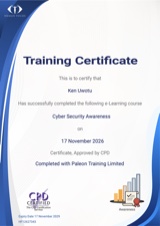
Cyber Security Awareness certificate CPD-approved certificate Cyber Security Awareness Human Focus · 17 November 2026 · valid to November 2029 · No. HF12627343

Designs and reviews: CyberSecure Workforce · AI Workflow Productivity & Process Transformation · AI + Cybersecurity Professional Accelerator

Ken founded Paleon Training. As Programme Director he designs and oversees all three corporate programmes and reviews every module before it is published; cybersecurity modules are written by authors with hands-on security experience. Before Paleon, he spent more than five years as an IT business consultant, including verification and validation work, and more than eight years as a senior consultant at Hellocare Consulting, advising UK care providers on regulation, compliance and governance.

How we write our courses

All corporate training is online, per learner or in a private company portal: your staff study self-paced. There are no live, facilitator-led or hybrid sessions. Every course meets these standards:

Real experience in the subject

Cybersecurity modules are written by authors with hands-on experience of information security work, such as security operations, risk or awareness programmes. AI modules are written by authors who use AI tools in real business work.

A recognised qualification

Course authors hold a relevant degree or a recognised industry certification, for example CompTIA Security+, ISC2, ISACA, Microsoft or Google certifications. We check certificates before anyone writes for us.

Written for non-technical staff

Our courses are for whole workforces, not IT teams. Every module is reviewed by our Programme Director to make sure risks and tools are explained clearly to people with no technical background.

Bound to confidentiality

Authors and reviewers sign a confidentiality agreement. Your staff study in a private company space that only your organisation can join, and examples from your organisation stay there.

Matched to your country and sector

Each country version covers its own data protection law, and scenarios are drawn from real sectors, so the examples match the threats and tasks your people actually face.

Kept up to date

Scams and AI tools change quickly. We review and update the course examples regularly, so your staff learn from current attacks and current tools.

See the course before you buy. Ask for a free leadership preview with your proposal, and your leadership team can work through sample modules online.

Questions

Frequently asked questions

What is CyberSecure Workforce?

A corporate cybersecurity awareness programme that teaches employees to recognise common threats, protect business information and report suspicious activity.

Who is the programme designed for?

Organisations of any size in Nigeria and every employee in them, from leadership to front-line staff.

Is the training suitable for non-technical employees?

Yes. It is written for people with no technical background.

Does our organisation need an IT department?

No. Smaller organisations without IT staff often benefit most, because staff habits are their main protection.

Is the training suitable for senior managers?

Yes. Leaders are frequent targets of impersonation, and short self-paced leadership modules are available.

Can the programme be customised?

Yes. Examples and exercises are adapted to your sector, departments and systems.

Can you train an entire workforce?

Yes, in phased cohorts or as an organisation-wide programme.

Can different departments receive tailored examples?

Yes. Finance, HR, Sales, Operations and others each get relevant scenarios.

Is the training available online?

Yes. All corporate training is online: staff learn self-paced in a private company space in the Paleon portal. There are no live, facilitator-led or hybrid sessions.

Can we have our own private company portal?

Yes. Your organisation gets its own private space in the Paleon portal. Staff join with one sign-up link, and your HR or L&D lead tracks progress from a manager login. We do not run sessions at your premises. Self-paced places have a fixed price per learner; organisation-wide rollouts are priced by proposal.

Does the programme cover phishing?

Yes, including email, SMS, WhatsApp, phone scams and business email compromise.

Does it cover ransomware awareness?

Yes: what it is, warning signs and what to do if you suspect an infection.

Does it cover AI-related cybersecurity risks?

Yes, including AI-written phishing, deepfakes and safe use of AI tools.

Does the programme include practical exercises?

Yes. Participants practise on realistic scenarios and a simulated incident.

Can we claim ITF reimbursement for this training?

Yes, if your organisation pays the ITF training levy: the ITF can refund up to 50% of the levy paid when it approves your training programme (source: Industrial Training Fund (Amendment) Act 2011). We provide attendance records and programme documentation.

Does the training cover data protection?

It builds awareness of handling personal and confidential data responsibly, in line with your obligations under the Nigeria Data Protection Act 2023. It is not legal advice.

Do you offer cybersecurity awareness training for companies in Lagos, Abuja, Port Harcourt, Warri, Ibadan and Kano?

Yes. CyberSecure Workforce is delivered online, per learner or in a private company portal, for companies in Lagos, Abuja, Port Harcourt, Warri, Ibadan and Kano and anywhere else in Nigeria. Staff study at their own pace around their working day. Company onboarding: 10 slots left for December 2026 start. Each slot covers portal setup, your staff sign-up link and a manager login for one organisation. Individual places bought online start today.

How much does cybersecurity awareness training for employees cost?

Online self-paced, it is ₦55,000 per learner. There are volume discounts of 10% for 10–49 learners, 20% for 50–199 and 30% for 200 or more, and 15% off when the same person takes all three programmes. Each place includes 12 months’ access; VAT is added where applicable. Invoice available on every order. Pay online by card, bank transfer or USSD, or tick “Send us an invoice” and we’ll email one within one working day. All training is online, per learner or in a private company portal, never live or facilitator-led. For an organisation-wide rollout, request a proposal with your team size and we will reply within one working day.

Can we pay by invoice?

Yes, for any order size. Training is set up once payment is received.

Can we combine cybersecurity training with AI training for our staff?

Yes. Many organisations pair CyberSecure Workforce with AI Workflow Productivity & Process Transformation, so staff learn to use AI tools and to recognise the new risks they bring. Both are available for companies in Nigeria.

How can we request a company portal proposal?

Complete the form below or email corporate@paleontraining.com. We reply within one working day.

Talk to us

Is your workforce ready for today's cyber threats?

Give your employees practical cybersecurity knowledge they can use every day: from recognising phishing and protecting company information to reporting suspicious activity and using AI safely.

Tell us about your organisation, your workforce and your concerns. We will recommend the right approach.

Prefer to talk first? Book a 20-minute call and we will cover your teams, goals and dates.

Email: corporate@paleontraining.com · WhatsApp: +44 7508 823495

We reply within one working day. Your details are used only to respond to this enquiry. Privacy Policy.