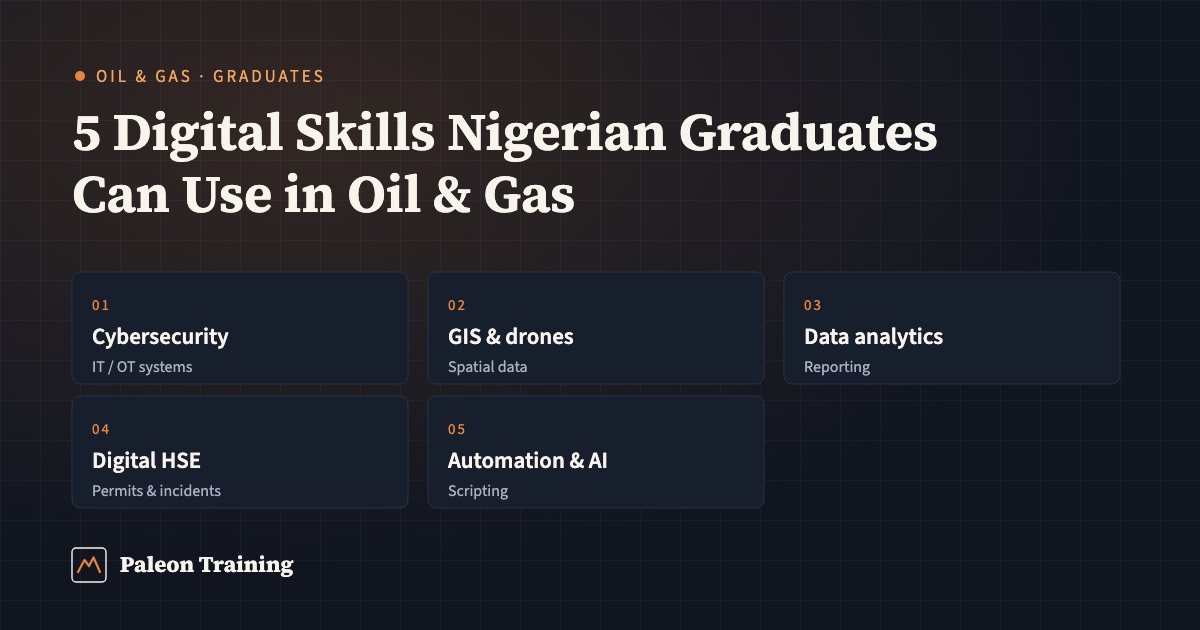
5 Digital Skills Nigerian Graduates Can Use in Oil & Gas
Five digital skill areas that are genuinely used in Nigeria's oil & gas sector — what each one is, where it shows up, and a project that proves you can do it.
Last reviewed: 24 September 2026 · Reviewed by Paleon Training
Short answer
What digital skills are useful in oil & gas?
Answer
Five digital skill areas map most directly onto work in Nigeria's oil & gas sector: cybersecurity (especially for industrial control systems), GIS and drone mapping, data analytics, digital HSE and operations systems, and automation, scripting and AI literacy. None replaces engineering or geoscience expertise; each lets a graduate contribute to how that expertise is recorded, monitored and protected.
This page is a skills guide. For the wider job search — IOCs vs. indigenous companies, NCDMB and where the jobs actually sit — see the oil & gas careers hub.
Key takeaways
Oil & gas runs on digital systems: production data, pipeline surveillance, spill and flare monitoring, permits and control systems all generate or depend on data.
The World Economic Forum's Future of Jobs Report 2025 ranks AI and big data, networks and cybersecurity, and technological literacy as the fastest-growing skills worldwide.
Nigerian regulators already publish data you can practise on — NOSDRA's Oil Spill Monitor and Gas Flare Tracker, and NUPRC's production reports.
For each skill, a small project using real, public Nigerian data is stronger evidence than a certificate on its own.
No skill or course guarantees a role; they make you a stronger candidate for specific, identifiable kinds of work.
Context
Why digital skills matter in Nigerian oil & gas now
Much of the industry's day-to-day decision-making now happens through data. The Nigerian Upstream Petroleum Regulatory Commission (NUPRC) publishes monthly crude oil and condensate production figures by terminal. NOSDRA, the oil spill agency, runs a public Oil Spill Monitor and a Gas Flare Tracker built on satellite observations. The Petroleum Industry Act 2021 added reporting duties, including those around Host Communities Development Trusts.
Every one of those systems needs people who can collect, check, analyse, secure and present data. That is where a graduate with a practical digital skill fits. You don't replace the petroleum engineer or the geoscientist; you work alongside them.
Skill 1
1. Cybersecurity for industrial and business systems
What it is
Protecting networks, data and the operational technology (OT) — SCADA and industrial control systems — that monitors and controls flow stations, terminals and pipelines.
Where it's used
IT security teams, OT/control-system teams, and incident response, governance and compliance functions (including Nigeria Data Protection Act 2023 obligations for personal data).
Oil & gas example
The 2021 Colonial Pipeline ransomware attack in the US began with one compromised VPN password that had no multi-factor authentication. The operator shut down pipeline operations for several days as a precaution. US agency CISA's review stresses separating IT from OT networks — a lesson that applies to any pipeline operator, Nigerian ones included.
Practical project
Write a one-page risk assessment for a fictional Niger Delta flow station: list its assets (engineering workstation, remote telemetry units, office network, contractor laptops), map the likely threats, and recommend five controls, such as MFA, network segmentation and a tested backup.
Career relevance
Entry routes include SOC analyst, IT/OT security support and GRC (governance, risk and compliance) assistant roles. See cybersecurity careers in oil & gas for more.
Geographic Information Systems (GIS) store and analyse location data. Drones and satellites are two of the ways that data is captured.
Where it's used
Pipeline right-of-way management, environmental baseline and spill mapping, field development planning, asset registers, and land and community mapping.
Oil & gas example
UNEP's 2011 Environmental Assessment of Ogoniland combined field sampling with remote sensing. The satellite analysis linked a rise in artisanal refining at Bodo West, Bonny LGA, to a roughly 10% loss of healthy mangrove cover between 2007 and 2011.
Practical project
Download spill records from NOSDRA's Oil Spill Monitor for one state. Map them in QGIS by cause and year, then write a half-page summary of the patterns you see.
Career relevance
GIS technician/analyst, drone data processor, and environmental or survey support roles. Regulated survey work still requires registered surveyors.
Cleaning, analysing and presenting data so a manager can make a decision — spreadsheets, SQL and dashboard tools such as Power BI, with Python as a later step.
Where it's used
Production reporting, maintenance planning, procurement, HSE statistics, regulatory returns, and Nigerian-content reporting to NCDMB.
Oil & gas example
NUPRC publishes monthly production data by terminal and stream. Analysts use data like this to track output trends and the effect of disruptions, such as shut-ins at export terminals.
Practical project
Build a one-page dashboard from twelve months of NUPRC production figures: output by terminal, month-on-month change, and three plain-English observations. Link the source for each figure.
Career relevance
Data or reporting analyst, planning assistant and business analyst roles, in operators and in the many service companies that report to them.
Skill 4
4. Digital HSE and operations systems
What it is
Using the digital tools that run health, safety and environment processes: electronic permit-to-work, incident and near-miss reporting, inspection checklists, and environmental monitoring records.
Where it's used
HSE departments, operations and maintenance teams, and contractors working on operator sites.
Oil & gas example
When a spill occurs, the operator, regulators and community representatives hold a Joint Investigation Visit (JIV) to establish its cause and volume. NOSDRA's Oil Spill Monitor publishes spill records, including details such as cause and estimated volume, so accurate digital records on site directly shape what gets reported.
Practical project
Design a digital near-miss reporting form (Google Forms or Microsoft Forms is fine), log ten fictional entries, and produce a monthly summary chart with two recommended corrective actions.
HSE Fundamentals is Paleon's practical HSE course for the oil & gas and industrial sectors.
Skill 5
5. Automation, scripting and AI literacy
What it is
Using scripts (usually Python), spreadsheet automation and AI tools to remove repetitive work. It also means knowing where AI output must be checked by a human.
Where it's used
Automating recurring reports, reconciling data from different systems, summarising documents, and supporting engineers and analysts.
Oil & gas example
The WEF's Future of Jobs Report 2025 lists AI and big data as the fastest-growing skill area across the industries it surveyed. In practice, a graduate who can automate a weekly production or HSE report saves a team hours and reduces copy-paste errors.
Practical project
Write a short Python script that reads a CSV of spill or production records, calculates monthly totals and exports a chart. Document where you would still need human review.
Career relevance
This skill strengthens the other four rather than standing alone as an entry-level job title.
Paleon does not currently run a dedicated programming or AI course. Treat this skill as something to build alongside one of the four above.
Start from the role, not the skill. Collect five real job adverts you would apply for and note which of the five skills they mention.
Use your degree. Geography, geology, surveying or environmental science graduates usually find GIS the natural fit. Computer science and engineering graduates often start with cybersecurity. Science and health graduates often start with HSE.
Pick one skill and finish one project before adding a second.
Not for most of the roles these five skills lead to. GIS, HSE, cybersecurity and data roles are open to graduates from a range of disciplines who can demonstrate the skill. Some technical and engineering roles do require a relevant degree or professional registration, so always check the individual job description.
Before you choose
Common mistakes
Collecting certificates without projects — an interviewer will ask what you built.
Learning a tool with no sector context — know which regulator, dataset or process your skill touches (NUPRC, NOSDRA, NCDMB, the PIA).
Treating HSE as a "soft" skill — it is close to a baseline expectation across the sector.
Trusting AI output without checking it — in a safety-critical industry, unverified numbers are a liability.
Assuming any single course guarantees a role — skills make you a stronger candidate; they don't replace an employer's own requirements.
Common questions
Frequently asked
Q1
Which digital skill is most in demand in Nigerian oil & gas?
No single public dataset ranks them for Nigeria specifically. Globally, the WEF's Future of Jobs Report 2025 names AI and big data, networks and cybersecurity, and technological literacy as the fastest-growing skills. In Nigerian oil & gas, HSE and GIS are the skills most directly used inside field operations.
Q2
Can a graduate without an engineering degree work in oil & gas?
Yes, in many roles. GIS, HSE, cybersecurity and data roles are open to graduates of various disciplines who can demonstrate the skill, although some technical roles do require a relevant degree or professional registration.
Q3
What project should I build to show oil & gas digital skills?
Use public Nigerian data: map NOSDRA Oil Spill Monitor records in QGIS, build a dashboard from NUPRC production figures, or write a cyber risk assessment for a fictional flow station. Document your method and sources.
Q4
Is cybersecurity really relevant to oil & gas?
Yes. Pipelines, terminals and flow stations rely on industrial control systems. The 2021 Colonial Pipeline ransomware attack showed how an IT security failure can halt physical operations.
Q5
How long does it take to learn one of these skills?
A focused beginner course can build foundations in a few weeks. Paleon's courses run 8–18 days of structured curriculum, but real confidence comes from finishing projects, not from course length alone.
Q6
Does completing a digital skills course guarantee an oil & gas job?
No. A course and a project make you a stronger candidate; hiring still depends on the employer's requirements, vacancies and your wider profile.
Sources & methodology
Where this guide's claims come from
The five skill areas were chosen from global employer survey evidence (WEF) and the public data and systems Nigerian regulators actually operate. The example projects use publicly available data. Paleon has no verifiable hiring-rate, salary or placement figures, so none are cited.