What Should You Learn During NYSC If You Want a Career in Oil & Gas?
The service year is one of the few stretches when many graduates have regular time to build something. Here is how to spend it if oil & gas is the goal.
Last reviewed: 24 September 2026 · Reviewed by Paleon Training
Short answer
What should a corps member learn for oil & gas?
Answer
Learn one sector-relevant digital skill (HSE, GIS and drone mapping, or cybersecurity are the closest fits). Add working knowledge of how the Nigerian industry is regulated, finish at least one project using real Nigerian data, and turn it into portfolio, CV and LinkedIn evidence. Do these four in that order. The skill gives you something to show; the sector knowledge gives it context.
This guide is specific to oil & gas. For corps members still choosing a direction, NYSC and your career compares the four main digital skills across sectors.
Key takeaways
NYSC is a 12-month service year; its SAED programme introduces skills at orientation camp, but building job-ready depth is up to you.
For oil & gas, HSE, GIS and drone mapping, and cybersecurity map most directly onto real roles.
Sector knowledge matters: know what NUPRC, NMDPRA, NCDMB and NOSDRA do, and what the Petroleum Industry Act 2021 changed.
A degree plus a certificate is common. A degree plus a skill, a project and a documented portfolio is much rarer.
Neither NYSC nor any course guarantees employment; they help you build evidence an employer can check.
Why NYSC
Why the service year is a useful window
The NYSC service year lasts twelve months. Many corps members have one day a week for Community Development Service (CDS), fixed hours at their Place of Primary Assignment, and evenings and weekends that are largely their own. NYSC's own Skills Acquisition and Entrepreneurship Development (SAED) programme starts at orientation camp and includes ICT tracks. That is a useful introduction, not a finished skill.
Graduate openings in oil & gas and its service companies are competitive. When many applicants hold similar degrees, evidence of what a candidate can already do becomes a practical way to stand out.
What to learn
The five things worth building during service
1. One digital skill with direct oil & gas use
Choose one and go deep:
HSE Fundamentals — hazard identification, risk assessment, permit-to-work, incident reporting. It is close to a baseline expectation for field and site roles. See HSE careers and training.
GIS and drone mapping — pipeline corridors, environmental monitoring, site mapping. A strong fit for geography, geology, surveying and environmental graduates. See how GIS is used across oil & gas operations.
Cybersecurity — protecting IT and industrial control systems. A strong fit for computer science and engineering graduates.
You should be able to explain, in two sentences each:
NUPRC regulates the upstream (exploration and production); NMDPRA regulates the midstream and downstream. Both were created by the Petroleum Industry Act 2021.
NCDMB implements the Nigerian Oil and Gas Industry Content Development Act 2010, which requires Nigerian participation and capacity building in the industry.
NOSDRA is responsible for oil spill detection and response.
Host Communities Development Trusts were created by the PIA to channel operator contributions to host communities.
This knowledge costs nothing but time, and it comes up in interviews.
3. Practical projects
One finished project is worth more than three unfinished courses. Use public Nigerian data where you can, such as NOSDRA's Oil Spill Monitor, its Gas Flare Tracker, or NUPRC's production reports.
4. Professional communication
Write a one-page summary of each project, as if for a manager. Oil & gas runs on reports, permits and handovers, so clear writing is part of the job.
5. Networking and visible evidence
Attend sector events where you can (including NCDMB and professional-body events). Connect with people doing the job you want, and post short, factual updates about your project on LinkedIn.
Roadmap
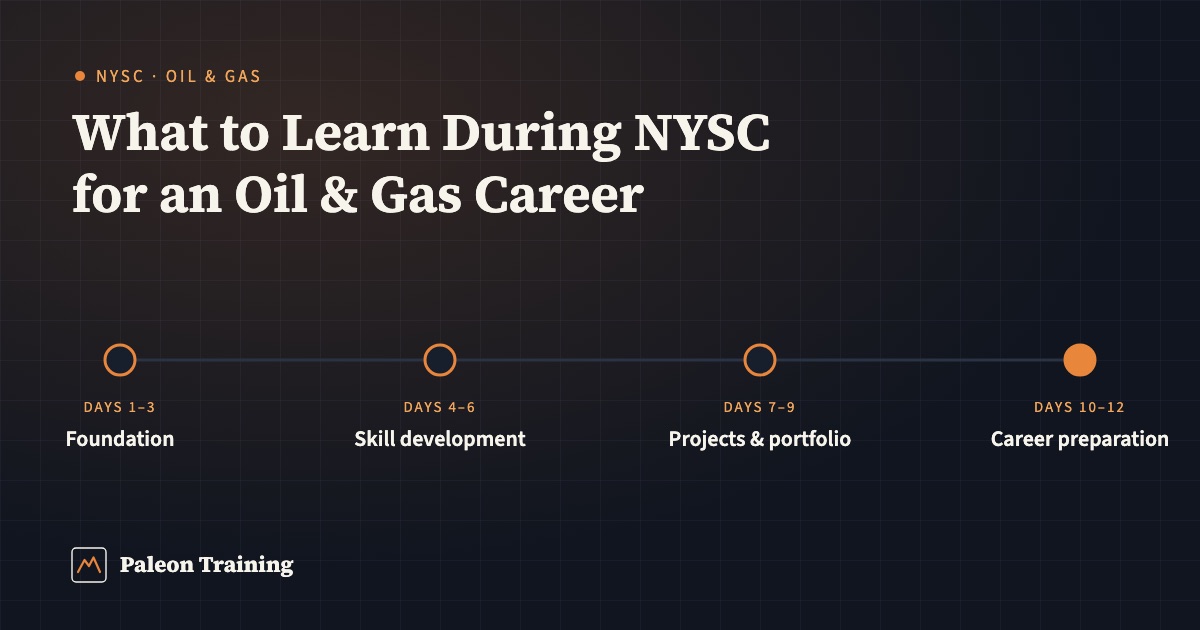
NYSC 12-day learning roadmap
Twelve focused study days — weekends, evenings or days away from your PPA — spread across your service year. Each day is roughly four hours.
Days 1–3
Foundation
Pick your skill using five real job adverts. Learn the sector map (NUPRC, NMDPRA, NCDMB, NOSDRA, PIA). Set up your tools, such as QGIS, a spreadsheet or a lab environment.
Days 4–6
Skill development
Work through structured lessons in your chosen skill. Practise on small exercises until you can do the core tasks without a tutorial open.
Days 7–9
Projects and portfolio
Complete one project with real or realistic oil & gas data. Write it up with the problem, your method, the result and its limitations. Publish it on a free portfolio page.
Days 10–12
Career preparation
Rewrite your CV around the project. Update LinkedIn. Prepare a two-minute verbal walkthrough of your work. Apply to specific roles, including service companies, not only IOCs.
"Mapped five years of Bayelsa spill records in QGIS"
Can it be checked?
Certificate only
Portfolio link, maps, write-up
Interview question
"What did you learn?"
"Walk me through your method"
Sector context
Often missing
Uses real Nigerian data and regulators
Certificates are useful, and some roles (particularly in HSE) formally require specific ones. The difference is that the second profile gives an interviewer something concrete to test. See how to build a portfolio during NYSC for the mechanics.
Before you start
Common mistakes corps members make
Waiting until the last month — start the roadmap in your first quarter of service.
Learning three skills at once — finish one project before starting a second skill.
Applying only to IOCs — indigenous operators and service companies also recruit graduates and are often overlooked.
Paying anyone who promises a job — legitimate employers don't sell placements.
Common questions
Frequently asked
Q1
What is the best skill to learn during NYSC for oil & gas?
HSE, GIS and drone mapping, and cybersecurity map most directly onto oil & gas roles. Choose based on your degree and the specific job adverts you are targeting, rather than on which skill sounds most impressive.
Q2
Is NYSC SAED enough to get an oil & gas job?
SAED is a useful introduction that starts at orientation camp, but most corps members will need further structured learning and a finished project before a skill is job-ready.
Q3
Can I learn a digital skill while serving at my PPA?
Yes. The 12-day roadmap on this page assumes about four hours per study day, spread across weekends, evenings or days away from your PPA.
Q4
What should I put on my CV after NYSC for oil & gas roles?
Lead with a specific project and its result, the tools you used, and relevant sector knowledge. List NYSC service with your PPA responsibilities; see our guide on listing NYSC on your CV.
Q5
Do oil & gas companies hire corps members?
Some organisations take corps members as PPA placements or run graduate trainee schemes, but these vary year to year and are competitive. No course or programme guarantees a place.
Q6
Does Paleon guarantee a job after training?
No. Paleon's courses teach practical skills through lessons, assignments and a capstone project; hiring decisions are always made by employers.
Sources & methodology
Where this guide's claims come from
Regulatory roles are taken from the Petroleum Industry Act 2021, the NOGICD Act 2010 and the agencies' own sites. The 12-day roadmap is Paleon's own recommended study plan, not an NYSC programme. No placement or hiring figures are cited because Paleon has none it can verify.