Why Nigerian Graduates Need Practical Digital Skills — Not Certificates Alone
Degrees and certificates remain important foundations. This guide explains what practical digital evidence adds, and how to assess it when you hire.
Last reviewed: 24 September 2026 · Reviewed by Paleon Training
Short answer
Why aren't certificates alone enough?
Answer
A degree shows that a graduate has mastered a body of knowledge, and a certificate shows that they completed a course. Neither, on its own, shows that they can apply a digital skill to a real problem using the tools and workflows your organisation uses. Practical evidence — projects, portfolios and demonstrated tasks — fills that gap. It works alongside academic qualifications, not instead of them.
This page is written for employers and hiring managers. Graduates looking for the job-seeker version should read Degree but no job?
Key takeaways
Academic qualifications provide the foundations: theory, discipline, and the ability to learn.
Practical digital evidence shows those foundations applied with real tools and workflows.
In the WEF's Future of Jobs Report 2025, 63% of employers named skills gaps as the biggest barrier to business transformation for 2025–2030.
Employers can assess practical capability directly, through portfolio walkthroughs and short work-sample tasks.
Project-based training closes gaps faster than generic, certificate-only programmes.
The balance
What degrees and certificates do well
A good degree is a long, assessed programme of study. It builds subject knowledge, analytical thinking, written communication and the discipline to finish demanding work. For many roles — engineering, geoscience, law, accounting — it is a professional requirement, often with registration on top. Industry certificates add value too: they show a defined syllabus was covered, and some roles, particularly in HSE, formally require specific ones.
None of that is in question. The gap is narrower and more specific: application. Being able to explain network segmentation is different from configuring it. Understanding coordinate systems is different from correctly reprojecting a pipeline dataset. And completing an analytics module is different from turning a messy production spreadsheet into a report a manager can trust.
Why it matters now
Digitalisation, skills gaps and graduate employability
The World Economic Forum's Future of Jobs Report 2025 surveyed over 1,000 employers across 55 economies. It found that 63% see skills gaps as the main barrier to transforming their business, and 85% plan to prioritise upskilling. AI and big data, networks and cybersecurity, and technological literacy top its list of fastest-growing skills.
Nigerian organisations face the same shift, and in oil & gas the effects are concrete:
Cybersecurity — operational technology now sits on networks, so an IT failure can become an operational one. The 2021 Colonial Pipeline incident in the US is the standard reference.
GIS and remote sensing — spill mapping, pipeline corridors and environmental baselines depend on spatial data. NOSDRA's public Gas Flare Tracker, for example, is built on satellite observations.
Data — NUPRC production reporting, NCDMB Nigerian-content reporting and HSE statistics all require accurate data handling.
Automation and AI — these can speed up reporting and analysis, but only in the hands of staff who know when output needs checking.
Graduate unemployment in Nigeria is a real and widely discussed issue (see what the data shows). Many graduates arrive with strong theory but limited opportunity to practise on industry tools. That is a gap employers can screen for, and help close.
Comparison
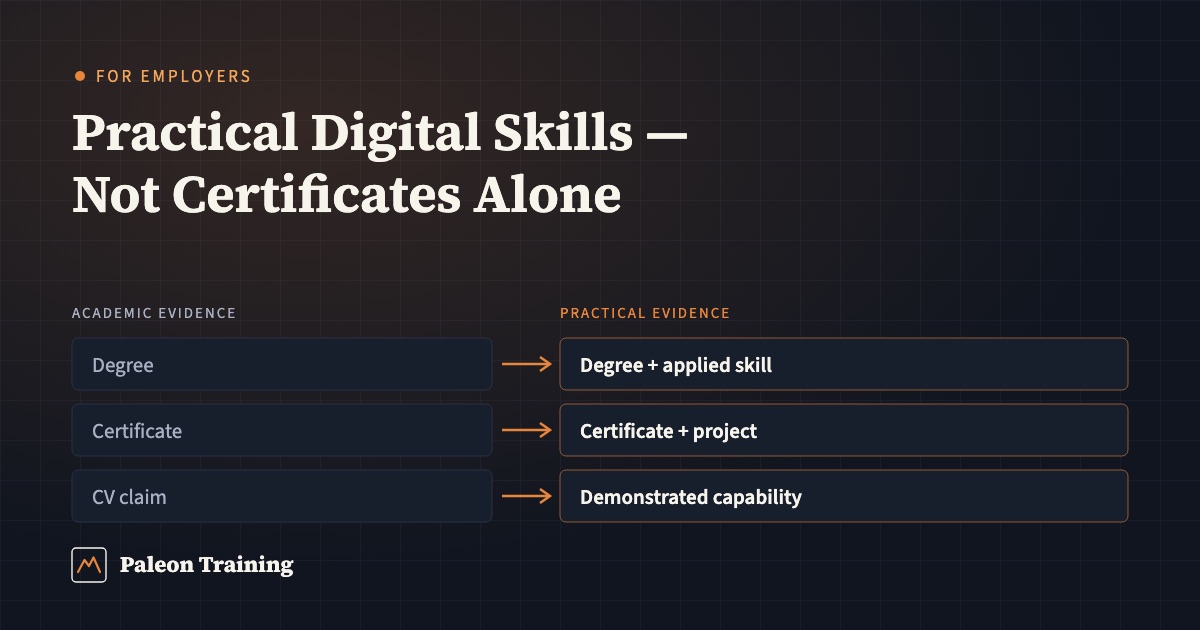
Academic evidence vs. practical evidence
Academic evidence
Practical evidence
What the practical version tells you
Degree
Degree + applied skill
The knowledge has been used on a real task
Certificate
Certificate + project
The syllabus produced a working output
CV claim
Demonstrated capability
The skill can be observed, not just stated
Theory
Applied knowledge
The candidate can handle messy, real inputs
Course completion
Portfolio evidence
Work quality can be inspected before hiring
Assessment
What should employers look for in a digitally capable graduate?
These criteria work for most digital roles in oil & gas and adjacent sectors. None requires specialist assessors.
A finished project they can walk you through. Ask: what was the problem, what data did you use, what did you decide, and what would you do differently? Unfinished or copied work usually shows up within three questions.
Tool fluency, not tool lists. Give a 30–60 minute work sample: clean a spreadsheet, reproject and map a small dataset in QGIS, or review a network diagram for obvious weaknesses.
Sector awareness. Can they explain which regulator or process their work touches — NUPRC reporting, NOSDRA spill records, permit-to-work, data protection under the NDPA 2023?
Documentation habits. Look for sources cited, method recorded and limitations stated. In regulated industries, undocumented work cannot be relied on.
Security and data hygiene. Check basic practice: password managers and MFA, not emailing sensitive files, and knowing what counts as personal data.
Judgement with AI tools. Ask how they check AI-generated output. A good answer names specific verification steps.
Plain-English communication. Can they explain the result to a non-specialist manager in two minutes?
A simple scoring approach
Score each criterion from 1 to 3 (not yet evident / developing / clearly evident). Weight the project walkthrough and work sample most heavily. Use the same rubric for every candidate so academic results, certificates and practical evidence are all considered consistently.
Closing the gap
Why project-based learning works
Project-based training requires learners to produce something: a map, a risk assessment, a report or a configured system. The output can be checked, so the training itself produces the evidence employers need. It also exposes misunderstandings early, which lectures and multiple-choice tests often miss.
For employers developing their own staff, the practical options are:
Graduate intake programmes that include a supervised project in the first 90 days.
Targeted upskilling in one skill area per team, rather than generic digital-literacy sessions.
Sector-specific capstones using data and scenarios from your own operations, anonymised where needed.
Are degrees still important when hiring for digital roles?
Yes. Degrees build subject knowledge, analytical thinking and discipline, and many roles legally or professionally require them. Practical evidence complements a degree; it does not replace it.
Q2
How can an employer test practical digital skills quickly?
Use a portfolio walkthrough plus a 30–60 minute work sample that mirrors a real task, such as cleaning a dataset, producing a simple map or reviewing a network diagram, and score it against a consistent rubric.
Q3
Is there evidence of a digital skills gap?
Yes. In the World Economic Forum's Future of Jobs Report 2025, 63% of surveyed employers identified skills gaps as the biggest barrier to business transformation for 2025–2030.
Q4
What digital skills matter most for oil & gas employers?
Cybersecurity, GIS and remote sensing, data analytics, digital HSE systems, and automation or AI literacy are the most directly applicable, depending on the team.
Q5
Should we stop asking for certificates?
No. Certificates confirm a syllabus was covered and some roles require specific ones. Pair them with a project or a work sample to see whether the learning can be applied.
Q6
Can Paleon train our existing graduate staff?
Yes. Paleon offers project-based corporate programmes in cybersecurity, GIS and drone mapping, and HSE, with sector applications. See the corporate training page for details.
Sources & methodology
Where this guide's claims come from
Survey figures come from the WEF Future of Jobs Report 2025, which covers employers across 55 economies, not Nigeria alone. The assessment criteria and scoring approach are Paleon's practical recommendations, not an external standard. No hiring outcome figures are cited.